Monday, February 22, 2010

What is the Difference Between Physical Therapists and Chiropractors?


While this seemingly simple question is commonly asked by patients, the resultant practitioner response is not often as simple. If I had a dollar for every time I have been asked this, I could retire today. First and foremost, each individual practitioner in each profession treats in his own unique way. This article will endeavour to enlighten you on the basic principles of difference between the two professions and shall provide a generalised overview.

Chiropractors diagnose, treat and prevent mechanical disorders of the musculoskeletal system, namely the spine. Their belief is that these disorders affect the nervous system and therefore one’s general health.

Physical therapy aims to maintain restore, maximise and develop one’s functional ability throughout life. Physical therapists are experts in rehabilitation and preventative therapy. It is a holistic approach to treatment that focuses not only on the physical, but the psychological, social and emotional well being of the individual through diagnosis, treatment and intervention.

Chiropractic treatment is concerned with vertebral subluxations of the spine. Treatment mainly involves spinal manipulation but can also include soft tissue therapy, electrotherapeutic modalities, exercises and health and lifestyle advice.

Physical therapy treatment involves mobilisations of joints, soft tissue massage, stretching, neuromuscular re-education, electrotherapeutic modalities and a large focus on rehabilitative exercises and a home exercise program.

Chiropractors practice autonomously and their service combines aspects from both alternative and mainstream medicine. It remains competitive with mainstream medicine and is therefore considered more of a complementary or alternative medicine.

Physical therapists on the other hand practice in numerous different settings such as outpatient clinics, inpatient rehabilitation facilities, extended care facilities, skilled nursing facilities, hospices, education and research centres, schools, occupational environments, fitness centres and private homes. Physical therapy has many specialities, the most common of which include orthopaedics, cardiopulmonary, neurologic, geriatrics and paediatrics.

Physical therapists work alongside and cooperate with mainstream medicine, largely due to the fact it is an evidence based profession that relies heavily on scientific research.

Hopefully this has provided you with a broad understanding of the fundamental differences between Chiropractors and physical therapists and has equipped you well enough to answer the notorious question.

Carla DiMattina

Wii-hab Increasing Rehab Potential


Lately, I’ve been reading many articles about the use of Nintendo’s Wii Fit as part of the rehabilitation process in many hospitals and outpatient clinics alike. We have been using the Wii Fit in the clinic where I work as a physical therapy aide for one year. We’ve found that it not only makes physical therapy sessions and the rehabilitation more fun, but has also improved our patients’ proprioception and balance as well.

Some therapists, however, are refuting the use of the Wii in a rehab setting as beneficial to patients. Eric Robertson, author of the blog site NPA think tank, thinks that the use of the Wii has potential to be harmful not only to the patients, but to the reputation of physical therapists (the blog can be found on this page (scroll down)). As a student of physical therapy, it is my belief that the Wii can be used successfully as a tool to enhance each patient’s treatment sessions. Robertson claims that since physical therapy is moving toward the doctoring profession, that therapist should be using their hands and doctorate education to make patients better. I would agree however; why can’t physical therapist use their knowledge of the body in conjunction with a tool that, not only makes therapy sessions interactive and fun, but gives therapists instant feedback as to where patients are shifting their weight? When is the last time someone was able to tell what percentage of a patient’s body weight was on the right leg versus the left just by looking at them? Not only is the Wii Fit a good biofeedback tool for patients to visualize their weight shifting, but with our doctoring and professional guiding hands, we can make PT more fun.

Even though some therapists disagree with the use of the Wii in a rehab setting, there have been a few studies that have shown improvements with peoples’ symptoms of Parkinson’s. Dr. Herz, an assistant professor of occupational therapy in the School of Allied Health Sciences and a study principal investigator along with Dr. John Morgan, neurologist, have found that using the Wii as a source of supplemental therapy leads “to physical, cognitive, psychological, and social aspects that address skills necessary to maintain independence and mobility in individuals with Parkinson’s disease.” (Parkinsons.org)

With the success of these kinds of studies (such as Decker et el from Rutgers University), other preliminary studies have started with positive outcomes showing the use of the Wii as a low cost rehabilitation tool. If physical therapists can make treatment sessions more fun while applying their doctorate knowledge of the body to make their patients better, then I think we should apply any means we can to make each patient happy and healthy.

For more current info on wiihabilitation, please visit http://www.wiihabilitation.org/

Snow Still Here


This year we have been blessed with a warmer-than-usual fall. Last week I was walking around in a t-shirt and jeans, while many of the central park joggers are still wearing shorts. As the next few weeks fall upon us however, the snow will eventually start falling. Only the hardcore runners will hit the upper loop of central park and the cyclers will start their indoor training. Ahhh the exchange of fresh air and the ever changing scenery of central park for the corner of your already cramped bedroom.

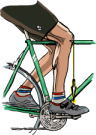
It is important for you cyclers to take this time to fine-tune your “fit” to the bike. The exchange of indoor for outdoor training provides you with the perfect chance to change and refine your positioning to optimize both your comfort, and your efficiency.

There are many different ways to measure your exact fit (25-30 degree flexion of the knee when the pedal is at the bottom most point. The distance from the top of the seat to the center of the bottom bracket is your inseam in centimeters multiplied by 0.883). Here are some basic things to look for when adjusting your bike’s fit:

1) Your hips should not rock back and forth when you pedal. Look for a position of the seat height where you hips stay level while you pedal.

2) Make sure your seat positioning isn’t too far forward or backward. With the pedal at 3 o’clock, make sure the most forward point of your knee is right over the ball of your foot and the axle of the pedal (use a plumb line)

3) If you use cleats, make sure that your cleats don’t make your feet too internally rotated (pointing toward the frame of the bike)

Remember, not everyone is symmetrical. For leg length discrepancies see your local physical therapist or orthotist for proper adjustment suggestions to your shoes. For everyone else, remember these three things while making your adjustments to the bike.

For expert fittings in NYC check out Signature Cycles.


"Jump" Back into Running!


Injured runners are often very eager to return to running as soon as possible. At times, it is very hard for me, as both a physical therapist and a runner, not to get caught up in their enthusiasm to get “back out on the road” quickly. My job as their therapist, however, is to make sure I get them back to running safely, without a greater risk for re-injury. One important phase that often gets overlooked when progressing their rehab program is the introduction of jumping/plyometrics. During one mile of running, your foot contacts the ground ~ 750 times! The deceleratory flexion that occurs during the landing phase of jumping/hopping is equivalent to the early stance phase in running. Therefore, one way to give the runner and the therapist confidence that they are ready to return to running is to put them through a series of jumping/plyometric drills. By practicing jumping/hopping skills before hitting the treadmill, both therapist AND patient can observe and practice technique to ensure that proper alignment and control is being maintained when the foot hits the ground ( i.e. the femur isn’t adducting and internally rotating excessively or knee falling into a valgus position). If their body can handle 750 jumps/hops (and they are able to maintain their form throughout), then, in theory, it should be prepared to handle one mile of running.

The Brigham and Women’s Hospital, Inc. Department of Rehabilitation, has developed their own return to running protocol.

I have found that putting my patients through their Phase II: Plyometric Routine has been a good way for me to critique their form, test their body’s tolerance to high impact and then determine whether or not they are ready to begin a return to running program. It has also benefitted as a tool to gauge cardiovascular endurance and to serve as a HEP.

Wednesday, February 10, 2010

The Overhead Athlete


With spring training hopefully right around the corner and winter strength and conditioning programs in full swing it is important to have some information with regards to the overhead athlete and some quick pointers in identifying possible small problems before they become larger pathologies
1. Take your time in the pre-season: Many players will jump right back into a similar training regiment as they had been participating with at the end of the prior season. As with any muscles if you don’t use it you will loose it so realize that the new baseline for activity is dramatically different. With training there are 3 variables which include: Frequency, Duration, and Intensity and your body is good at adapting to a 10% change to ONE of these variables. Very simply put – don’t go from throwing for ten minutes to fifteen minutes & 50 to 100 feet in the same session
2. Your follow through is the most important part of throwing: Our bodies are at a biomechanical advantage to have greater force into internal rotation (one of the motions for throwing) than it is to produce force with the external rotators (the muscle group to decelerate the arm after the ball is released). A player can decrease the amount of stress placed on these smaller muscles by giving them a longer period of time to slow the arm by having an adequate follow through. In the non-throwing population typical range of motion for the shoulder is 180 degrees with overhead activities (flexion and abduction) Internal rotation 0~80 deg (depending on which medical association you reference) and External rotation of 0-90. Current research suggests that it is not uncommon to find a decrease in passive Internal rotation in throwing athletes and a decrease in the force production (in particular the “eccentric” or contraction while lengthening) of the External Rotators of the shoulder.
3. Ask for help early and often: In many instances our body will first ask us to stop an activity, then tell us to stop an activity, and finally make us stop an activity. Be aware of the early signs of problems which will include but are not limited to: pain, decreased force production, decreased ability to recover, and unintentional adjustments in mechanics. The human body in general will take a “path of least resistance” which will, unfortunately, cause bad habits to be further reinforced.
Health care and physical education is now leaning towards prevention, as it should be, with the focus on avoidance of injury as the primary focus. Before starting a season or sport it is necessary to have the proper coaching and advice in order to critique form and personal function. Experts in this area are, but not limited to: physical therapists, athletic trainers, Certified strength and conditioning specialists, and PE teachers. A team approach must be taken for every athlete and the participant has to be patient when working with a health care professional due to the necessity to build a good foundation first in order to have the ability to perform higher level tasks
In closing – it is important to have the proper preseason workout and have the proper support system to ensure good habits early on in the season and early in an athletes career. Athletes need to know when to ask for help and where to look for it throughout the entire process from the first toss to the final out of the championship. Patience is a quality that many lack but is absolutely necessary for a long career in a sport such as baseball where physical demands are ever-present and competition is everywhere.

Fresh Look at Foam Rolling

Whether you are a therapist, trainer, or simply someone immersed in the health and fitness world, you are most likely very familiar with the use of the foam roller for myofascial release. The foam roller has numerous functions, but its aid in releasing the fascia and underlying muscle tissue is certainly its most popular. Despite this fact, I constantly witness patients or clients who seem uncomfortable on or frustrated with this modality.
Incorrect positioning on the roller seems to be what keeps most beginners from realizing the maximum benefits of the exercise. The following video is an attempt to help us rectify common issues people encounter. Using some of these basic tips with patients will hopefully change the mindset they have about the quality of this stretching method.
WATCH VIDEO

Low-Level Laser Therapy May Be Helpful for Chronic Neck Pain

Due to the positive response generated from the last LLLT article, I thought I’d add to the current research on this modality.
New meta-analyses reported in the lastest online edition of Lancet report positive pain outcomes for LLLT for patients with acute and chronic neck pain.
The authors summarize, “Whatever the mechanism of action, clinical benefits of LLLT occur both when LLLT is used as monotherapy and in the context of a regular exercise and stretching programme,” the review authors conclude. “In clinical settings, combination with an exercise programme is probably preferable.”
See Medscape for further details of this article.
Again, I would like to see recommended dosage/wavelength parameters with regards to LLLT and specific injuries. Only after pooling the results of such double-blind placebo trials can we develop standardized parameters for the use of LLLT.

Benjamin Gold